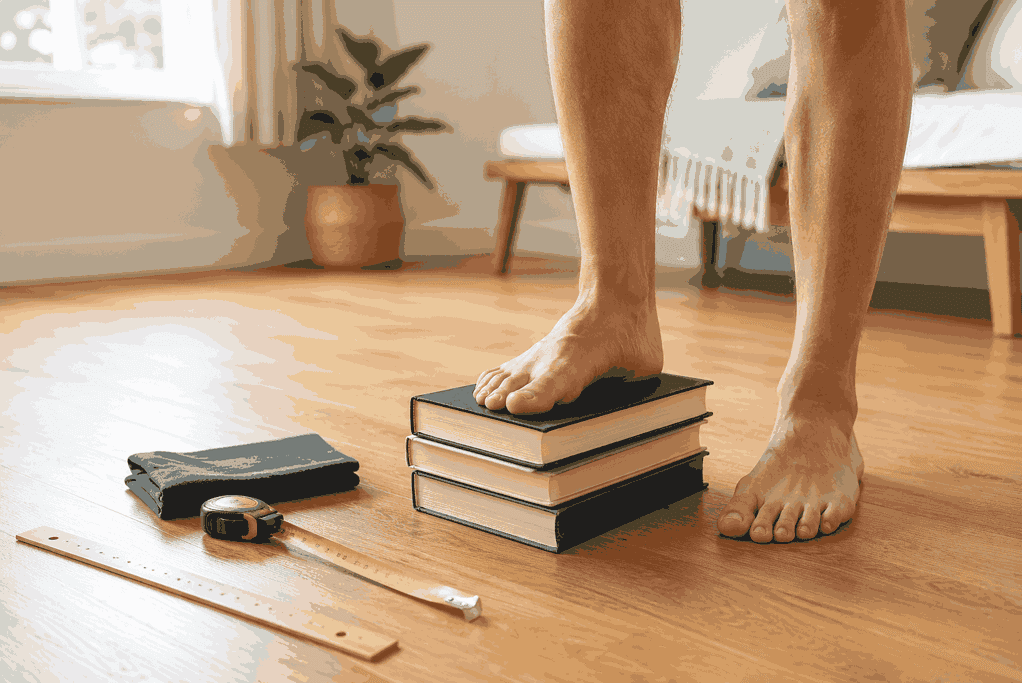
How to Measure Leg Length Discrepancy
If you suspect one of your legs is shorter than the other, the first question is always the same: by how much? The answer determines everything — whether you need a lift at all, what height to start with, and whether an in-shoe insert is enough or you need an external custom shoe lift. The good news: you can get a reliable first measurement at home with items you already own. This guide walks you through three methods, from simplest to most accurate.
Before You Start: Structural vs. Functional Discrepancy
Not every uneven-leg feeling means a bone is actually shorter. A structural discrepancy means the bone itself (femur or tibia) is shorter — common after hip or knee replacement, a fracture, or from birth. A functional discrepancy means the legs are the same length, but pelvic tilt, scoliosis, or muscle tightness makes one act shorter. Home measurement helps with both, but the fix differs — if you’re unsure of the cause, start with our overview of what causes leg length discrepancy.
Method 1: The Book Stack Test (Easiest — 5 Minutes)
This is the method most physical therapists teach first, and it’s the same principle behind professional lift fitting.
- Stand barefoot on a hard floor in front of a mirror, feet hip-width apart.
- Have a helper look at the back of your pelvis and place their hands flat on the top of each hip bone (the iliac crests). If one hand sits visibly lower, that’s your shorter side.
- Slide thin, firm boards or magazines (not soft towels) under the shorter foot, one at a time, until your helper sees both hands level and you feel balanced.
- Measure the height of the stack with a ruler. That’s your starting lift estimate.
Tip: Most people feel best starting with a lift that corrects half to two-thirds of the measured difference, not 100% of it. Your body has adapted to the imbalance for years — full correction on day one can feel strange. Our guide to choosing the correct shoe lift height covers this in detail. For a week-by-week picture of that adjustment, see our guide to getting used to a shoe lift.
Method 2: The Tape Measure Method (More Precise)
This measures the actual bone length, which helps confirm whether your discrepancy is structural.
- Lie flat on your back on a firm surface, legs straight and relaxed.
- Have your helper find the bony point at the front of your hip (the ASIS — the bump you feel at the front of your waistband).
- Run a tape measure from that point to the bottom tip of the inner ankle bone on the same leg.
- Repeat on the other leg. Measure each leg twice and average the numbers.
A difference of 1/4 inch (6 mm) or more is generally where people start noticing symptoms — hip pain, lower back ache, uneven shoe wear, or a visible limp. Differences over 3/4 inch almost always benefit from correction.
Method 3: Our Free Measurement Kit (Most Accurate at Home)
Home methods are a great starting point, but small errors add up — a soft floor, a tilted pelvis, an uneven book stack. That’s exactly why we created a free measurement kit: we mail you precise measuring materials with step-by-step instructions, you take your measurement at home without pressure, and you only order when you’re confident in the number. Shipping is free both ways and there’s zero obligation — request your free kit on our homepage.
What Your Measurement Means
| Measured difference | What it usually means |
|---|---|
| Under 1/4″ (6 mm) | Usually no correction needed unless you have symptoms |
| 1/4″ – 1/2″ | An internal heel lift inside the shoe often works |
| 1/2″ – 1″ | Internal lifts get uncomfortable — a built-in sole modification is more stable |
| Over 1″ | An external custom lift built into the sole is the reliable option |
If your discrepancy appeared after surgery, you’re not alone — it’s one of the most common reasons customers come to us. We wrote a dedicated guide about leg length discrepancy after hip replacement surgery.
From Measurement to Modified Shoe
Once you have your number, the rest is simple: you mail us any shoe you already love — sneakers, boots, dress shoes, sandals — and we build a precision lift from 1/8″ up to 4″ directly into the sole, contoured so it looks factory-made. See exactly how our shoe lift process works, check our transparent pricing (starting at $64.99), or place your order when you’re ready. The work itself takes 1–3 business days once your shoes reach us.
Frequently Asked Questions
Can I measure leg length discrepancy without a helper?
The book stack test is difficult alone because you can’t see your own pelvis. If nobody can help, stand in front of a mirror wearing shorts and look at the creases where your legs meet your hips — a visibly higher crease on one side suggests a discrepancy. For a reliable number, use our free measurement kit, which is designed for solo use.
How accurate are home measurements compared to an X-ray?
A careful home measurement typically lands within 1/8″ to 1/4″ of an imaging study — accurate enough to choose a starting lift height. X-ray or CT scanogram remains the gold standard, so for discrepancies over 1 inch, or if you have pain, confirm with your doctor first.
Should my shoe lift match my full measured difference?
Usually no. Most specialists recommend starting at one-half to two-thirds of the measured difference and adjusting from there. Your muscles and joints have adapted to the imbalance, and gradual correction is more comfortable.
Which leg gets the lift?
The lift always goes on the shorter leg’s shoe — it raises that side so your pelvis sits level. If your measurements conflict about which side is shorter, re-measure or use our free kit before ordering.
Still not sure about your measurement? Request our free measurement kit — no charge, free shipping both ways, zero obligation. Fill out the short form on our homepage and it ships the next business day.
Ready to Get Started?
Start by measuring at home with our free measurement kit — free shipping both ways, zero obligation. Then check our transparent shoe lift pricing (from $64.99) and place your order when you’re ready.